
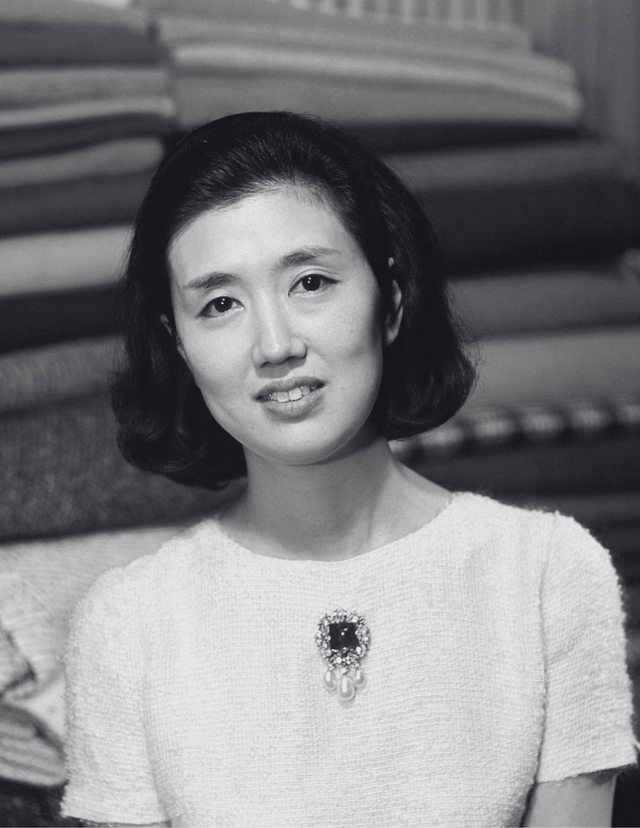


Hanae Mori: The First Japanese Fashion Icon to Reach the World
Before becoming an internationally recognized symbol of elegance, Hanae Mori was a young woman in post-war Japan driven by a rare conviction for her time: fashion could be a powerful expression of identity.
Born in Shimane Prefecture and educated in Japanese literature, Hanae Mori developed an early sensitivity to storytelling, symbolism, and personal expression. She often recalled being the only child around her wearing Western-style clothing - a sign of her instinctive desire to explore new perspectives.
Her career began in Tokyo, in a small atelier located across from a cinema. There, she created costumes for the emerging generation of Japanese filmmakers, contributing to nearly one hundred films. These formative years shaped her precision, her understanding of movement, and her belief that clothing could reveal personality.
In 1961, through Japan’s influential fashion magazine Soen, she introduced the concept of the “Vital Type”: a modern woman who was independent, active, and intellectually engaged. A woman who worked, created, and chose her own path.
Long before conversations around female empowerment became widespread, Hanae Mori was already defining its essence.
Her international journey began in 1965, when she presented her first collection in New York. Entitled Miyabiyaka, it marked a turning point in her career and introduced the world to her unique vision.
American media described her work as “East Meets West” - a dialogue between Japanese refinement and Western modernity. Her fluid silks, sophisticated patterns, and distinctive silhouettes immediately attracted attention from leading luxury retailers.
Her creations caught the eye of Diana Vreeland, the legendary editor-in-chief of Vogue, who helped introduce her vision to a global audience. Photographed by Richard Avedon, her designs became symbols of a new kind of elegance.
Her international recognition eventually led her to Paris, the capital of haute couture. In 1977, Hanae Mori became the first Japanese and Asian designer officially admitted as a member of the Chambre Syndicale de la Haute Couture.
Her collections brought a new language to Paris: Japanese sensitivity combined with French craftsmanship, blending tradition and modernity.
At the heart of her universe was one defining symbol: the butterfly.
Representing transformation, freedom, and femininity, the butterfly became her signature and earned her the nickname “Madame Butterfly.”
Beyond fashion, Hanae Mori was also an entrepreneur and cultural pioneer. She built a global house that combined artistic vision with strategic thinking - a remarkable achievement for a woman of her generation.
In 2026, Tokyo celebrates the centenary of her birth with a major retrospective exhibition highlighting her journey between Tokyo, New York, and Paris.
More than a fashion designer, Hanae Mori created a bridge between cultures.
Her legacy continues today through Hanae Mori fragrances, where the same dialogue between East and West, delicacy and confidence, lives on.
Some brands follow their time. Others help define it.
Hanae Mori belongs to the latter.

0 Comments
There are no comments for this article. Be the first one to leave a message!